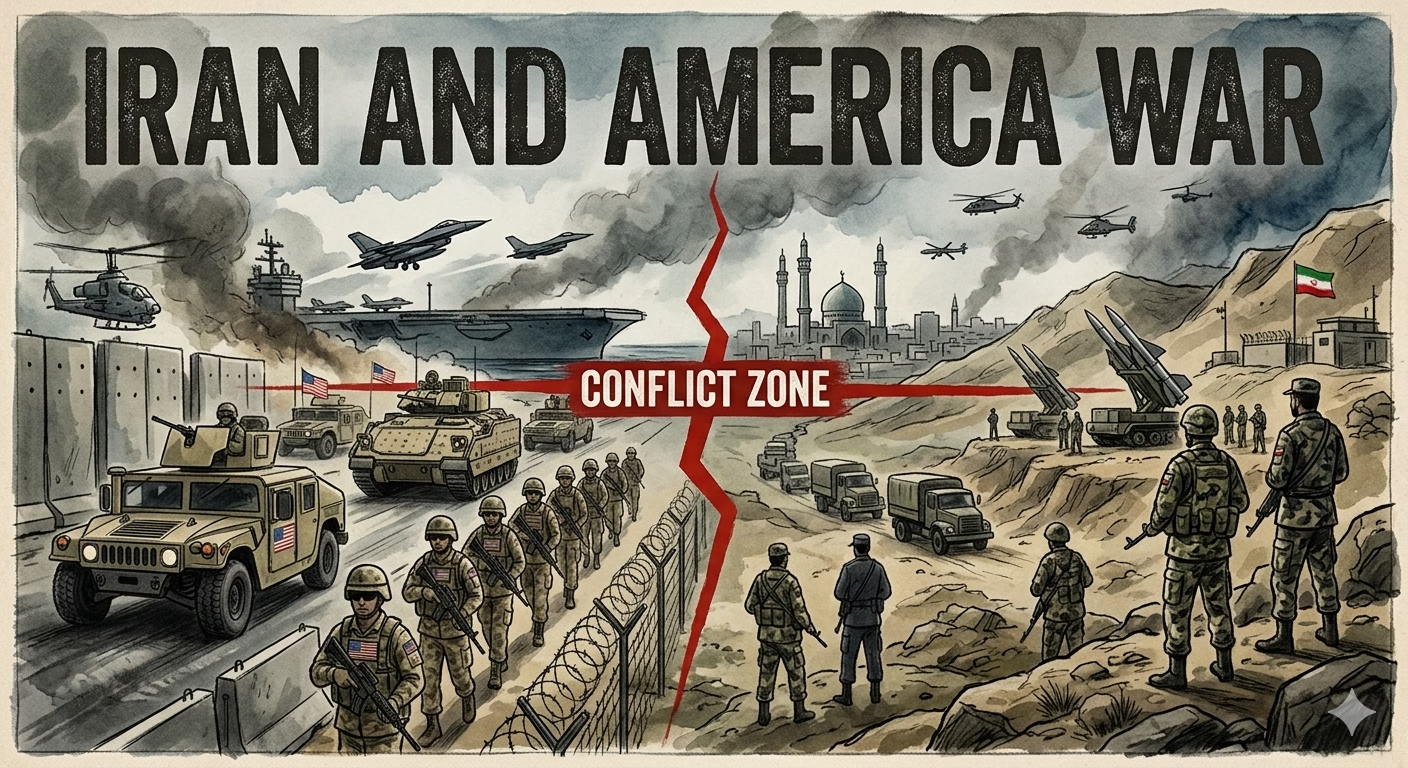
Iran vs America: The 2026 War Explained — Causes, Conflict, and Global Consequences
In one of the most dramatic and consequential military escalations of the 21st century, the United States and Iran are now locked in an active armed conflict that has sent shockwaves through global politics, energy markets, and international diplomacy. What began as decades of tension, sanctions, and proxy warfare has exploded into a full-scale military confrontation in 2026 — changing the face of the Middle East and the entire world order. For in-depth coverage, visit the BBC Middle East section
This blog post breaks down the full story of the Iran America war 2026 — the causes, the key events, the global consequences, and what might come next
Background: Iran America War 2026 — Decades of Tensions
The roots of the Iran-America conflict go back to 1979, when the Islamic Revolution overthrew the US-backed Shah of Iran and radical students seized the American Embassy in Tehran, holding 52 Americans hostage for 444 days. That single event poisoned relations between the two nations for decades to come.
Over the following years, the US imposed sweeping economic sanctions on Iran, accusing it of sponsoring terrorism through groups like Hamas and Hezbollah, destabilizing the region, and — most critically — pursuing a covert nuclear weapons program. Iran, for its part, maintained it had the sovereign right to develop nuclear technology for peaceful purposes.
The 2015 JCPOA (Joint Comprehensive Plan of Action) briefly offered a diplomatic off-ramp, but when President Donald Trump withdrew from the deal in 2018 and reimposed maximum-pressure sanctions, any chance for lasting peace began to crumble. A fresh cycle of provocations, proxy attacks, and military buildups followed through 2023, 2024, and into 2025.
The 2025 Twelve-Day War: How the Iran America War 2026 Began
Tensions boiled over in June 2025 when the US and Israel jointly struck Iranian nuclear facilities during what became known as the Twelve-Day War. Although the strikes were described as limited and targeted, they significantly degraded Iran’s air defense and nuclear infrastructure. Iran retaliated with drone and missile attacks on Israeli territory and US military bases across the Gulf.
The war ended without a formal resolution, leaving both sides more hostile and more militarized than before. Iran began rapid reconstruction of its military assets. The US, under President Trump, kept a massive naval presence in the Persian Gulf. The stage was set for the next — and far more devastating — round.
January 2026: Protests, Threats, and the Build-Up to War in the Iran America War 2026
In January 2026, Iran witnessed its largest anti-government protests since the 1979 Islamic Revolution. When Iranian security forces killed thousands of demonstrators, Trump responded with a series of escalating threats on Truth Social, warning of a “lock and loaded” military response if the killings continued.
Throughout January, Trump deployed a massive US naval armada to the Middle East, including the aircraft carriers USS Abraham Lincoln and USS Gerald R. Ford, accompanied by guided-missile destroyers, fighter jets, and B-2 bombers. Simultaneously, Iran and the US engaged in indirect nuclear negotiations in February 2026, with Iranian Foreign Minister Abbas Araghchi claiming a “historic” deal was “within reach.”
But behind the scenes, both Israel and the US had already made a fateful decision. The Iran America war 2026 was now inevitable.
February 28, 2026: Operation Epic Fury Begins
At 2:30 a.m. EST on February 28, 2026, President Trump released a video statement announcing the launch of military strikes against Iran — codenamed Operation Epic Fury. In just the first 12 hours, US and Israeli forces conducted nearly 900 airstrikes across Iran, targeting missile storage facilities, air defense systems, naval assets, military command centers, and most shockingly — the Iranian leadership itself. This marked the official start of the Iran America war 2026.
Among those killed in the strikes was Supreme Leader Ali Khamenei, whose compound in eastern Tehran was obliterated. The assassination of Iran’s supreme leader — a figure who had ruled the country for over 35 years — sent a shockwave through the region and the world. Trump stated clearly that the objective was effective regime change, citing Iran’s “menacing activities” including support for Hamas and Hezbollah, the Iran hostage crisis legacy, and the killing of protesters.
Iran Fights Back: Missiles, Drones, and the Strait of Hormuz
Iran’s response was swift and devastating. Within hours of the initial US-Israeli strikes, Iran launched hundreds of ballistic missiles and suicide drones at targets across the region:
- US military bases in Bahrain, Jordan, Kuwait, Qatar, Saudi Arabia, Turkey, and the UAE
- Israeli population centers and military installations
- Gulf state civilian infrastructure including oil facilities
Most critically, Iran moved to restrict navigation through the Strait of Hormuz — the narrow waterway through which approximately 20% of the world’s oil supply passes. The blockade sent Brent crude prices surging above $100 per barrel, triggering fears of a global energy crisis and economic recession.
Despite losing Khamenei, Iran did not collapse. Mojtaba Khamenei, the supreme leader’s son, was swiftly installed as the new leader, with the powerful Islamic Revolutionary Guard Corps (IRGC) pledging full allegiance. The regime proved far more resilient than Washington had anticipated.
The War Drags On: An Unending Conflict
As of March 2026, the war has entered a grinding phase with no clear end in sight. The US and Israel claim to have struck over 5,000 targets inside Iran, severely degrading its air force and naval capabilities. Yet the Tehran government has not fallen, and the IRGC continues to launch retaliatory strikes on American and allied interests throughout the Gulf. The Iran America war 2026 continues to reshape global geopolitics.
Thick, toxic smoke from burning oil facilities now blankets Tehran, a city of 10 million people. Civilians are living underground, sheltering in parking garages to escape the thunder of explosions. Gulf states — including Saudi Arabia, the UAE, Qatar, and Kuwait — are caught in the crossfire, with Iranian missiles striking their territory despite their nominal neutrality.
Trump has oscillated between demanding Iran’s “unconditional surrender” and offering amnesty to IRGC commanders who switch sides. Diplomatically, on March 1, 2026, Trump announced that the US had accepted an Iranian proposal for further negotiations, suggesting the conflict could last another four to five weeks at minimum.
Global Impact: Oil, Economy, and World Politics
The Iran America war 2026 is not just a regional conflict — its consequences are being felt worldwide:
- Oil prices have surged past $100 per barrel, fueling inflation across Europe, Asia, and the Americas
- Global shipping has been disrupted due to threats in the Persian Gulf and Strait of Hormuz
- The Indian economy, heavily reliant on Gulf oil imports and home to millions of workers in the region, faces significant economic pressure
- Russia and China have condemned the US strikes, raising geopolitical fault lines between East and West
- European nations have called for immediate ceasefire negotiations and a return to diplomacy
- Global financial markets have experienced sharp volatility since the conflict began
Was War Inevitable? The Debate Over US Strategy
Critics of the Biden and Trump administrations argue that the war could have been avoided with sustained diplomatic engagement. The collapse of the JCPOA, the maximum-pressure sanctions campaign, and the series of military provocations throughout 2023–2025 created a ticking time bomb that eventually detonated.
Supporters of the strikes, however, argue that Iran was months away from possessing a nuclear weapon and that military action was the only viable way to prevent a nuclear-armed Iran from permanently destabilizing the Middle East. They point to Iran’s support for Hamas (responsible for the October 7, 2023 attacks on Israel), Hezbollah’s campaign against Lebanon and Israel, and Houthi attacks on Red Sea shipping as evidence that Iran had to be confronted.
The debate over whether the war was justified, necessary, or strategically sound will define American foreign policy discussions for years to come.
What Comes Next?
The outcome of the Iran America war 2026 remains deeply uncertain. Several scenarios are on the table:
- Negotiated Ceasefire: Iran and the US reach a deal that halts hostilities in exchange for sanctions relief and security guarantees
- Regime Collapse: Continued strikes and internal pressure cause the Iranian government to fall, leading to a transitional government backed by Washington
- Prolonged Attrition: The war grinds on for months or years with neither side achieving its objectives — draining US resources and devastating the Iranian civilian population
- Regional Escalation: Other actors — including Hezbollah, Russia, or China — get drawn in, turning the conflict into a wider war with catastrophic global consequences
None of these outcomes are guaranteed, and the fog of war makes prediction nearly impossible. What is certain is that the world will never look quite the same after 2026.
Conclusion: A World at a Crossroads
The Iran America war 2026 represents a defining moment in modern history. It is the product of decades of failed diplomacy, mutual mistrust, proxy warfare, and the relentless pursuit of nuclear capability. Whatever the final outcome, the human cost — on both sides — is already staggering.
For ordinary Iranians, US service members, and millions of people worldwide facing rising fuel prices and economic uncertainty, the Iran America war 2026 is not a geopolitical abstraction. It is a lived reality with generational consequences.
As the world watches and waits, one thing is clear: the decisions made in the coming weeks will shape the Middle East — and the global order — for decades to come. Stay updated with Reelsefeel for the latest news and in-depth analysis on the Iran-America conflict and all breaking global events.America conflict and all breaking global events.
Tags: Iran America war, Iran US conflict 2026, Operation Epic Fury, Iran war latest news, US strikes on Iran, Iran nuclear program, Middle East war 2026, Trump Iran war, Iran vs USA, Strait of Hormuz, Iran war consequences, Ali Khamenei killed, Iran war update March 2026
