When is India’s Gaganyan misson launching in 2025?
India’s Gaganyaan Mission: A Historic Leap in Human Spaceflight
India’s Gaganyaan program marks a groundbreaking achievement in the nation’s space ambitions. Led by the Indian Space Research Organisation (ISRO), launching
it aims to send Indian astronauts into low Earth orbit (LEO) for a three-day mission, safely returning them back to Earth. This milestone positions India among an elite group of countries capable of crewed spaceflight.
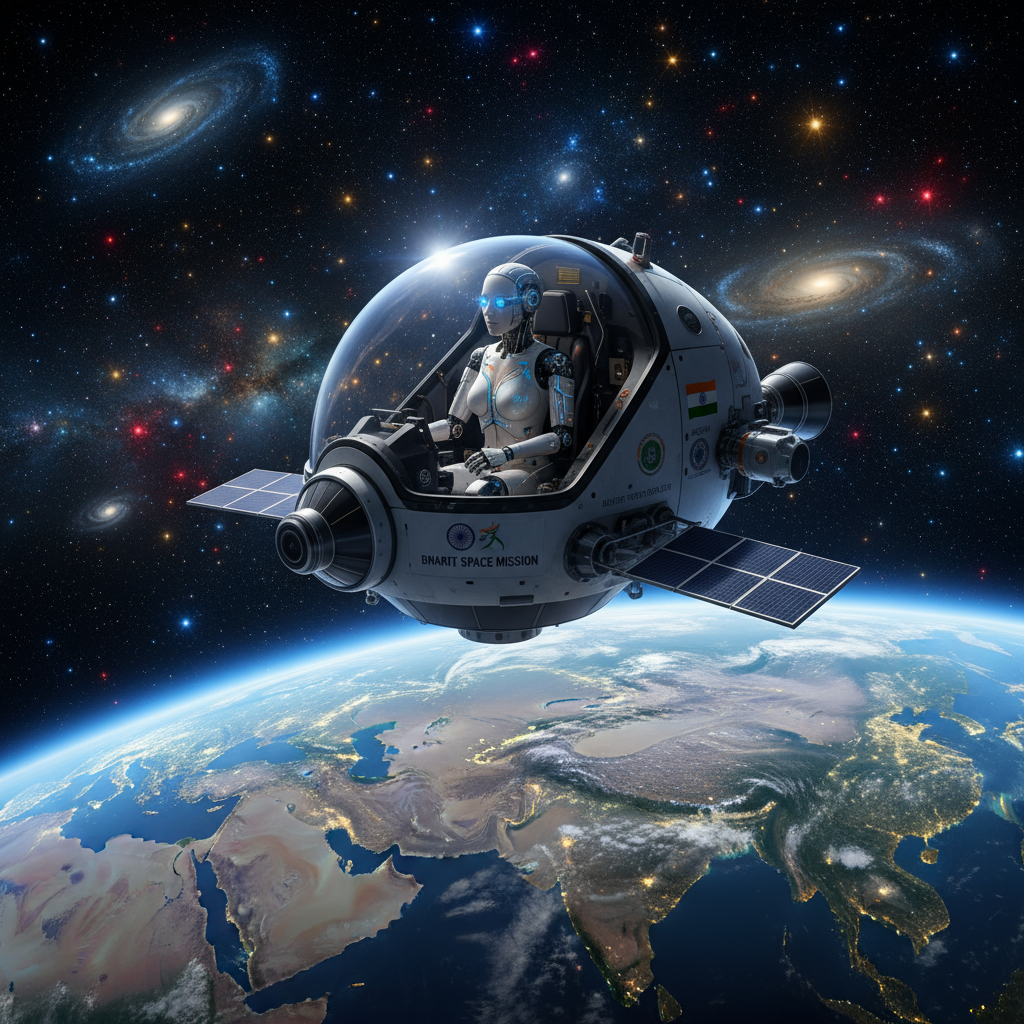
The journey, spanning over a decade of development, is fast approaching a key moment: the first uncrewed test flight planned for December 2025, featuring Vyommitra—an AI-powered half-humanoid robot designed to simulate human presence in space.
Beyond this, ISRO has bold plans including a modular space station by 2035 and a crewed lunar landing mission by 2040, steering India toward becoming a leading space power by 2047.
The Gaganyaan Mission: India’s First Manned Spaceflight
Announced by Prime Minister Narendra Modi in 2018, the Gaganyaan mission is India’s first project aimed at independently sending humans to space. The plan involves sending a crew of three astronauts to orbit the Earth at an altitude of 400 km for approximately three days—making India the fourth country after Russia, the US, and China to achieve this feat.
The core objectives of the mission include demonstrating human spaceflight technology, conducting scientific experiments in microgravity, and enhancing India’s capacity to carry out complex space missions. Gaganyaan will also pioneer life support systems, emergency protocols, and in-orbit task handling crucial for astronaut safety. ISRO’s prior successes with unmanned missions like Chandrayaan and Mangalyaan have provided a strong foundation for this ambitious next step.
Spacecraft Design and Technology
The Gaganyaan spacecraft consists of two main parts: the Crew Module (CM) and the Service Module (SM).

- Crew Module: This is the astronaut habitat, designed as a truncated cone with a double-layer structure. The inner metallic shell is pressurized and protected externally by a thermal shield to endure the high temperatures during re-entry. It houses life support systems, communication, navigation, environmental controls (for temperature, pressure, humidity, and CO₂), and emergency escape mechanisms.
- Service Module: Connected to the Crew Module, the service module carries propulsion systems, power supplies, and avionics. It manages orbital maneuvers, including orbit stabilization and controlled re-entry, powered by liquid bipropellant engines developed from ISRO’s proven technology.
The launch vehicle is a human-rated version of the LVM3 (Launch Vehicle Mark III), equipped with enhanced safety features such as a Crew Escape System (CES) to rapidly eject the crew module in emergencies during launch.
Vyommitra: India’s AI Half-Humanoid Robot Astronaut
Ahead of human flights, ISRO will conduct uncrewed missions starting with a launch in December 2025, featuring Vyommitra. This AI-driven half-humanoid robot is designed to perform human-like functions and responses aboard the spacecraft, ensuring that systems work flawlessly before humans enter the voyage.
Vyommitra (meaning “Sky Friend” in Sanskrit) monitors vital cabin parameters like temperature, pressure, humidity, and carbon dioxide levels. It can operate control panels, interact with ground controllers through voice recognition in Hindi and English, and provide real-time system updates. Made primarily from aluminum alloy, Vyommitra withstands extreme vibrations and stresses of spaceflight.
This robot’s mission is crucial for testing life support systems and environmental controls, gathering data necessary to refine safety measures for the upcoming crewed missions planned for 2026.
Future Missions and India’s Space Vision
Following the initial uncrewed test flight, ISRO plans two more unmanned missions in 2026 to further validate spacecraft systems and astronaut safety. The first human spaceflight mission is targeted for early 2027.
India’s astronaut corps is training intensively with international partners, including Russia, to prepare for the physical and operational challenges of space travel. Expanding this team is a priority as India accelerates its space exploration efforts.
ISRO envisions establishing the Bharatiya Antariksha Station (BAS), a modular space station, by 2035. This will enable long-term research in orbit and act as a platform for more advanced space missions. A crewed lunar landing is slated for around 2040, aiming to build a lunar outpost focused on scientific research and sustained human presence on the Moon.
These bold goals align with Prime Minister Modi’s vision to elevate India as a global space power by the 100th anniversary of independence in 2047.
Collaborations and Technological Innovations
Gaganyaan is a collaborative national effort involving the Defence Research and Development Organisation (DRDO), Indian Air Force, Navy, and other institutions. Russia remains a key partner, providing astronaut training and technology support critical for mission success.
Significant technological achievements powering Gaganyaan include:
- Certification and safety validation of a human-rated launch vehicle
- Advanced life support systems mimicking Earth-like conditions inside the spacecraft
- Comprehensive escape and abort systems to safeguard crew in emergencies
- Integration of AI and robotic technology for system monitoring and assistance
- State-of-the-art thermal protection and re-entry technologies ensuring safe Earth return
Why Gaganyaan Will Transform India’s Space Journey
Successfully launching and returning Indian astronauts will propel India dramatically forward in global science and technology. This will drive innovation, boost STEM education, and stimulate high-tech industries across manufacturing, software, and research domains.
Internationally, India will join a select club of nations with autonomous human spaceflight capabilities, enhancing its influence in diplomacy, defense, and space governance. The advancements also pave the way for future collaborations in space exploration and planetary research, further expanding India’s presence beyond Earth.
India’s Gaganyaan mission—with its critical Vyommitra test flight planned for December 2025—is a testament to Indian innovation and its commitment to space exploration. It embodies national pride, technological excellence, and a vision for a spacefaring future that inspires generations and establishes India as a key player in humanity’s quest beyond our planet.
This version makes the content engaging, easy to read, and optimized with relevant keywords for search engines, while ensuring uniqueness and clarity for readers.
